pondelok 9. januára 2012

The Ascent of Money: A Financial History of The World by Niall Ferguson

Bread, cash, dosh, dough, loot, lucre, moolah, readies, the wherewithal: Call it what you like, it matters. To Christians, love of it is the root of all evil. To generals, it's the sinews of war. To revolutionaries, it's the chains of labor. But in The Ascent of Money, Niall Ferguson shows that finance is in fact the foundation of human progress. What's more, he reveals financial history as the essential backstory behind all history.

Through Ferguson's expert lens familiar historical landmarks appear in a new and sharper financial focus. Suddenly, the civilization of the Renaissance looks very different: a boom in the market for art and architecture made possible when Italian bankers adopted Arabic mathematics. The rise of the Dutch republic is reinterpreted as the triumph of the world's first modern bond market over insolvent Habsburg absolutism. And the origins of the French Revolution are traced back to a stock market bubble caused by a convicted Scot murderer.

With the clarity and verve for which he is known, Ferguson elucidates key financial institutions and concepts by showing where they came from. What is money? What do banks do? What's the difference between a stock and a bond? Why buy insurance or real estate? And what exactly does a hedge fund do?

This is history for the present. Ferguson travels to post-Katrina New Orleans to ask why the free market can't provide adequate protection against catastrophe. He delves into the origins of the subprime mortgage crisis.

Perhaps most important, The Ascent of Money documents how a new financial revolution is propelling the world's biggest countries, India and China, from poverty to wealth in the space of a single generation—an economic transformation unprecedented in human history.

Yet the central lesson of the financial history is that sooner or later every bubble bursts—sooner or later the bearish sellers outnumber the bullish buyers, sooner or later greed flips into fear. And that's why, whether you're scraping by or rolling in it, there's never been a better time to understand the ascent of money.


Episode 1:


Episode 2


Episode 3


Episode 4


Episode 5


Episode 6

sobota 7. januára 2012

Secrets of Body Language

Body language is a form of non-verbal communication, which consists of body posture, gestures, facial expressions, and eye movements. Humans send and interpret such signals almost entirely subconsciously.

John Borg attests that human communication consists of 93 percent body language and paralinguistic cues, while only 7% of communication consists of words themselves; however, Albert Mehrabian, the researcher whose 1960s work is the source of these statistics, has stated that this is a misunderstanding of the findings (see Misinterpretation of Mehrabian's rule). Others assert that "Research has suggested that between 60 and 70 percent of all meaning is derived from nonverbal behavior."

Body language may provide clues as to the attitude or state of mind of a person. For example, it may indicate aggression, attentiveness, boredom, relaxed state, pleasure, amusement, and intoxication, among many other cues.


Gas Discharge Visualization technique and Kirlian Energy

Kirlian photography refers to a form of photogram made with electricity. It is named after Semyon Kirlian, who in 1939 accidentally discovered that if an object on a photographic plate is connected to a source of voltage an image is produced on the photographic plate.

Kirlian's work, from 1939 onward, involved an independent rediscovery of a phenomenon and technique variously called "electrography", "electrophotography" and "corona discharge photography." The Kirlian technique is contact photography, in which the subject is in direct contact with a film placed upon a charged metal plate.


Current research continues by Dr. Konstantin Korotkov in the Russian University, St. Petersburg State Technical University of Informational Technologies, Mechanics and Optics. Dr. Korotkov has published several books. He uses GDV (Gas Discharge Visualization) based on the Kirlian Effect. GDV instruments use glass electrodes to create a pulsed electrical field excitation (called "perturbation technique") to measure electro-photonic glow.

This is a playlist (5 videos, 40 minutes) about the GDV technique:


Wikipedia:

http://en.wikipedia.org/wiki/Gas_Discharge_Visualization
(Same: http://en.wikipedia.org/wiki/Kirlian_photography)

The History of the Devil

Lucifer, Beelzebub, The Beast, Satan... He has been called many names and taken many strange different forms over the ages. So where does the concept of the traditional evil come from? The History of the Devil goes back to the ancient Middle East, even before the Old Testament to find the roots of Satan. The answer is in the ancient Mesopotamia. In Zoroastrianism it was believed that the all-knowing good God was Ahura Mazda, the one Uncreated Creator, and Ahriman was his antithesis, the God of chaos, the dark and evil one. Probably the bases of these teachings like heaven and hell, good and evil were transferred to the other monotheistic religions.

The idea of "God's evil enemy" has been around for thousands of years. While early Christian clerics used the Devil as a symbol of heresy, the concept did not begin with the Christian Bible, but rather in ancient Persia some 3500 year ago. Since then, he has acquired horns, a forked tail and innumerable names in all aspects of world culture as well as a central role in the way we think.

THE HISTORY OF THE DEVIL looks at how our concept of evil, as symbolized by the Devil, has evolved over the centuries to fit the needs of government, churches, demagogues and opportunists everywhere.


A History of God

The idea of a single devine being - God, Yahweh, Allah - has existed for over 4,000 years. But the history of God is also the history of human struggle. While Judaism, Islam and Christianity proclaim the goodness of God, organised religion has too often been the catalyst for violence and ineradicable prejudice.

In this fascinating, extensive and original account of the evolution of belief, Karen Armstrong examines Western socitety's unerring fidelity to this idea of One God and the many conflicting convictions it engenders. A controversial, extraordinary story of worship and war, A History of God confronts the most fundamental fact - or fiction - of our lives.


Lost Worlds - Atlantis

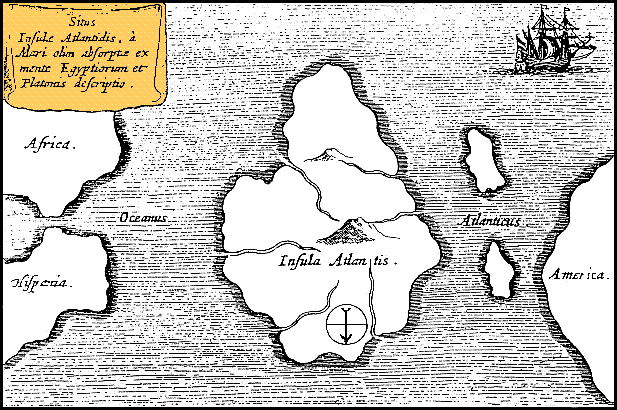
Atlantis is a legendary island first mentioned in Plato's dialogues Timaeus and Critias, written about 360 BC. According to Plato, Atlantis was a naval power lying "in front of the Pillars of Hercules" that conquered many parts of Western Europe and Africa 9,000 years before the time of Solon, or approximately 9600 BC. After a failed attempt to invade Athens, Atlantis sank into the ocean "in a single day and night of misfortune".


Wikipedia:

http://en.wikipedia.org/wiki/Atlantis

Lost Worlds - Knights Templar

They defended the Holy Land for 200 years before a fall from grace. Now watch as the archaeologist unearth their city of Tortosa, now in the suburbs of modern day Tartus in Syria.


Wikipedia:

http://en.wikipedia.org/wiki/Knights_Templar